This website has been established to provide information about the Indigenous languages and cultures of the First Nations people traditionally associated with the Gascoyne Region of Western Australia. It is based on research carried out by the authors between 1978 and the present, and also includes earlier work such as the information collected by Geoffrey N. O’Grady and Terry Klokeid in 1968. We are grateful to our language teachers for sharing their knowledge with us.
The Indigenous languages of the Gascoyne Region can be classified together on the basis of shared vocabulary and grammatical structure into the following groups:
- Kartu languages — comprising Yinggarda, Malgana, Wajarri, Badimaya and Nhanda
- Kanyara languages — comprising Bayungu, Thalanyji, Burduna and Binigura
- Mantharta languages — comprising Tharrgari, Thiin, Jiwarli and Warriyangga
To the north of these groups we find the Ngayarta languages that occupy most of the Pilbara region of Western Australia.
Within each group there are many similarities in the words people use and the way sentences are put together. People from the same language group would often be able to understand each other fairly easily, after some exposure to the other languages. In addition, people often married outside their group, so children grew up multilingual and speaking two or more languages. It was not uncommon in the 1970s and 1980s to meet Aboriginal people in the Gascoyne Region who could speak between two and five languages, and be able to understand even more.
The following table shows some similarities and differences between the languages.
| English | Yinggarda | Bayungu | Dhalanyji | Burduna | Tharrgari | Jiwarli |
| ‘person’ | gardu | ganyara | ganyara | ganyara | ganyara | mantharda |
| ‘woman’ | nyanjilba | nyanjil | wardirra | wardirra | macangu | burrardi |
| ‘dog’ | thuthu | gabarla | gabarla | gabarla | thuthu | thuthu |
| ‘water’ | baba | gayulu | gayulu | gayulu | bawa | baba |
| ‘meat’ | mandu | murla | murla | buja | birru | birru |
| ‘went’ | yanaburru | bunima | buninha | buninyangu | yanaca | yananja |
| ‘my’ | ngathangu | ngathangu | jurdi | ngayangu | nganayi | nganaju |
| ‘you’ | nyinda | nyinda | nyinda | ngii | nhurra | nhurra |
The following map shows the approximate locations of language groups when Europeans first settled in the area — note that the language names on the map are written according to an earlier spelling system.
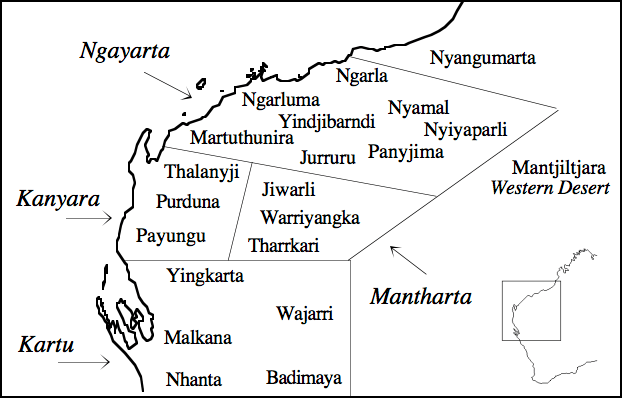
 Languages of the Gascoyne Region, Western Australia